
How to Refinish a Bathroom Vanity Cabinet So the Paint Survives the Steam
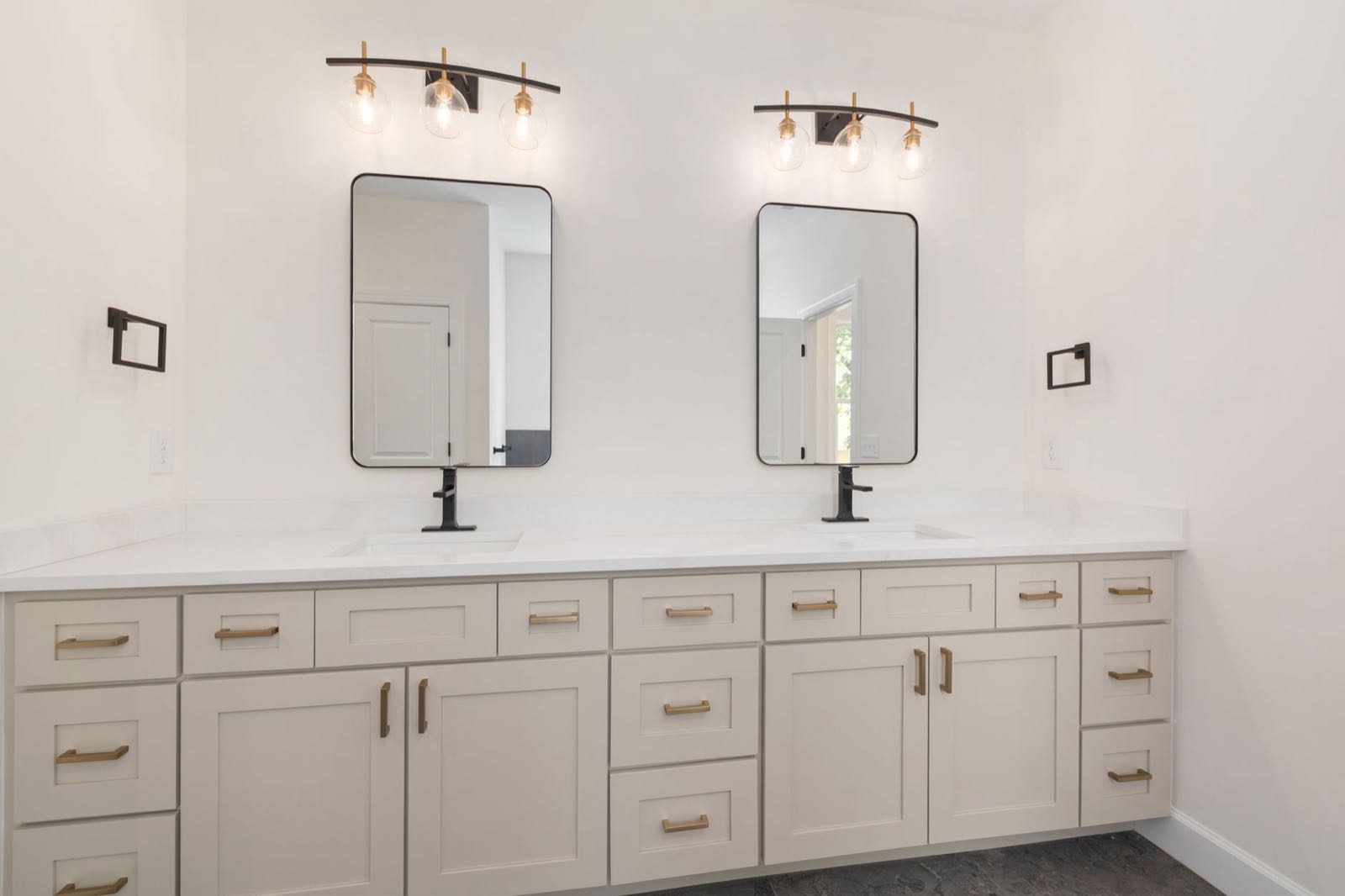
To refinish a bathroom vanity cabinet, empty it, take off the doors, drawer fronts, and hardware, clean off the soap and hairspray film, scuff-sand the old finish, apply a bonding primer, then spray or brush a satin or semi-gloss topcoat and let it cure before anything goes back on. It's the same process as kitchen cabinets, on a smaller box that sits next to a shower.
That last part is what changes the job. A vanity gets steam from above and plumbing from below, so the finishes that fail are the ones where paint never bonded and moisture found the weak spot. (Kitchen cabinets get grease. Vanities get steam, toothpaste, and a wet towel hung over the door every morning. Mine included.)
Can you refinish a bathroom vanity cabinet?
Yes, if the box is solid. Solid wood, plywood, and MDF vanities all take paint well. Laminate and thermofoil can be painted too, with a bonding primer, because standard primer doesn't grip those slick surfaces.
The place to check is the floor of the sink base. Empty the cabinet, then press on the bottom panel and the lower edges of the sides. Particleboard that's soft, swollen, or flaking from an old leak won't hold paint or screws, and refinishing doesn't fix it.
Age and color don't disqualify anything. A builder-grade oak vanity from the 1990s is a good candidate if the box is dry and square.
How much does it cost to refinish a bathroom vanity?
We price vanities the same way we price kitchens: $150 to $175 per door and $75 to $85 per drawer. A single-sink vanity with 2 doors and 3 drawers runs $525 to $605. A double vanity with 4 doors and 6 drawers runs $1,050 to $1,210.
Because the price follows the door and drawer count, the width of the vanity doesn't set the cost. A wide vanity with open shelving underneath can cost less than a narrow one that's all drawers.
Doing it yourself costs the price of materials and a weekend. For one small vanity, that's usually the better deal, and there's more on that below.
How do you refinish a bathroom vanity step by step?
Empty the cabinet and take off the doors, drawer fronts, and hardware. Label each piece with where it hangs, because vanity doors often look identical and fit slightly differently. Tape off the countertop, the sink, the wall above the backsplash, and the floor around the base.
Clean every surface next, door edges included. Bathrooms don't have kitchen grease, but they have a film of soap, hairspray, lotion, and toothpaste that paint won't stick to. Use a degreasing cleaner, rinse it off, and let everything dry completely.
Then scuff-sand to break the old sheen. The goal is to give primer something to grip, not to strip back to bare wood. Fill dents and old hardware holes you won't reuse, caulk the gaps where panels meet the frame, and vacuum and wipe off every bit of dust.
Prime with a bonding primer. Over water marks or dark stained wood that could bleed through, use a stain-blocking primer. Then apply thin coats of cabinet-grade paint, sanding lightly between them. If your home was built before 1978 and the vanity has old paint on it, test for lead before you sand, and follow the EPA's lead-safe work practices if it comes back positive.
Should you spray or brush vanity doors?
Spray them if you can. Doors and drawer fronts laid flat and sprayed come out smooth in a way brushwork rarely matches, which is why we take them off and spray them, and paint the box in place.
Brushing works on a vanity better than on a whole kitchen, because there are only a few doors and you can take your time on each. Lay them flat, brush with the grain, and keep the coats thin. A heavy coat runs on the edges and stays soft longer, and the edges are where vanity doors get grabbed, bumped, and splashed.
What paint finish is best for a bathroom vanity?
Satin or semi-gloss. Semi-gloss is shinier and wipes down easiest, which matters around a sink, but it shows every flaw in the prep. Satin is more forgiving and still washable. Flat and eggshell aren't durable enough for cabinet doors, in a bathroom or anywhere else.
Use a paint made for cabinets, not leftover wall paint. Wall paint stays slightly soft after it dries, so vanity doors painted with it stick where they close against the frame and peel at the contact points.
Do you need to paint the inside of a vanity cabinet?
No, and most people don't. The inside of a sink base sits behind closed doors with the plumbing and the cleaning supplies, so paint in there takes abuse and almost never gets seen. We don't include cabinet interiors by default, though they're available on request.
The exception is a vanity with open shelving or glass doors, where the inside is part of the look. And if the inside has water stains or mildew, deal with the moisture and clean it whether you paint it or not.
Should you replace the hardware when you refinish a vanity?
Decide before you prime, not after. New pulls with a different hole spacing mean filling the old holes and drilling new ones, and that filling has to happen during prep so it disappears under the primer. Swap the hardware after the paint is on and the patched holes show.
Check the hinges while the doors are off. A hinge screw that spins in a stripped or swollen hole lets the door sag, and a sagging door rubs its edge against the frame until the paint wears through to the wood.
Does bathroom humidity ruin a painted vanity?
Humidity doesn't ruin a well-prepped finish, but it finds every shortcut. Paint over soap film, or over a slick surface without a bonding primer, can hold for a while in a dry room. In a bathroom that steams up every morning, moisture works under the weak spots and the finish starts lifting at the edges and around the pulls.
In Southwest Florida, the bathroom is humid before anyone turns the shower on. Run the exhaust fan during and after showers, and if the fan doesn't clear the mirror, get it fixed before you paint. A painted vanity in a room that never dries out is fighting the room.
Check under the sink for leaks while the cabinet is empty. A slow drip at a supply line or the drain swells the bottom panel from underneath, and nothing on the outside of the box protects against that. If there's mildew inside the cabinet, fix the moisture source and clean it before you prime. The CDC publishes plain guidance on cleaning up mold safely.
How long before you can use a refinished vanity?
Until the finish has cured enough to handle, which is later than when it feels dry. Paint dries to the touch well before it cures, and a door rehung too early picks up hinge marks, fingerprints, and sticky spots where it closes against the frame.
Humidity slows that cure, and the bathroom is the worst room in the house to cure paint in. Keep the doors and drawer fronts drying in an air-conditioned room, not in the bathroom or a closed garage. If the schedule is flexible, the dry season, roughly November through April, is the easier window.
Should you refinish a vanity yourself or hire someone?
If it's one vanity with a few doors, do it yourself. It's a reasonable weekend project with a brush, the box is small enough that a mistake is easy to sand out and redo, and you don't need to hire us for it.
Hiring makes sense when there are several vanities, when you want a sprayed finish a brush can't match, or when the vanities are going along with a kitchen job that's already happening. Adding a double vanity with 4 doors and 6 drawers to a kitchen refinish adds $1,050 to $1,210, and those doors go through the same spray setup as the kitchen doors.
When should you replace a bathroom vanity instead of refinishing it?
Replace it when the box has water damage, when you want a different size or layout, or when you're replacing the top anyway and the cabinet underneath isn't worth keeping.
Refinishing changes the doors, the drawer fronts, and the outside of the box. It doesn't change the countertop, the sink, the faucet, or where the plumbing comes out of the wall. If you want a second sink where there's one, that's a new vanity, and paint on the old one is money spent on a cabinet you're about to tear out.
And if the bottom panel is swollen from a leak, replace the vanity. Paint over a failing box looks good for a few months, and then you're paying for the vanity twice.
Frequently Asked Questions
Yes, the vanity stays where it is: the doors and drawer fronts come off for painting, and the box is painted in place. That's how we handle every cabinet job, kitchen or bath.